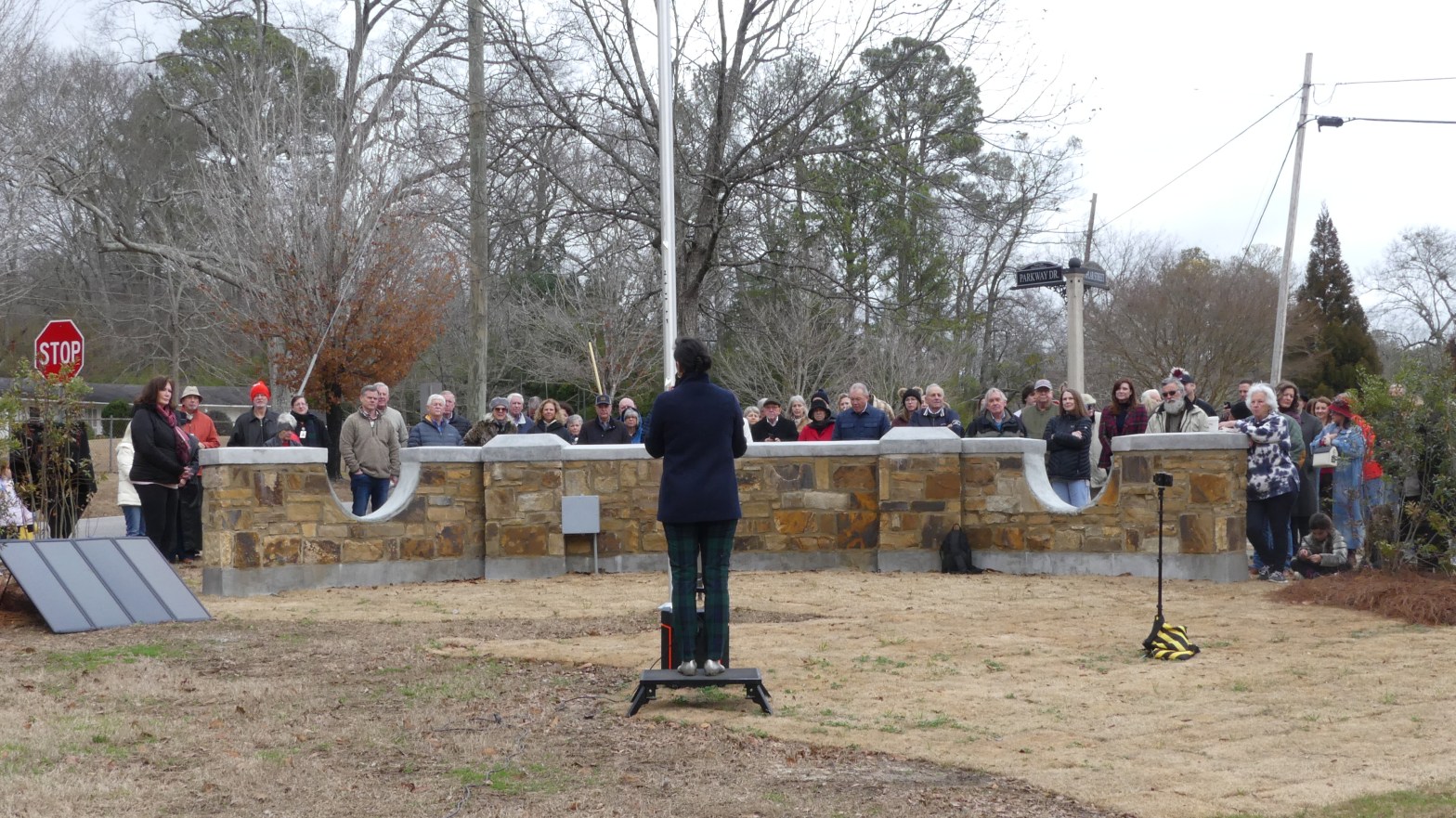
Below is the full video of the stone gateways dedication ceremony in Trussville, Alabama’s Cahaba Project, a National Register of Historic Places landmark.
Below the video is the full text of the speech.
Enjoy.
Amy Peterson O’Brien’s Dedication Ceremony Speech
Welcome! Today is an exciting day! It’s a day that recognizes our past and our present in a very visible and tangible way. The name and dates of our historic village, the people honored by these bricks, and the bronze dedication plaque, all tell Trussville’s story. By design, these gateways are a beautiful way to welcome people to Trussville’s historic district, for generations to come.
I have the privilege of serving this historic community and the city of Trussville as the president of the Cahaba Homestead Heritage Foundation, an educational nonprofit organization that spearheaded this Stone Gateway project in 2022.
The Cahaba Project is the birthplace of modern-day Trussville. In 1936, this area was little more than an idyllic setting along the Cahaba River, where an inoperative furnace stood, along with heaps of slag, and wooden shacks of unemployed furnace workers. Within only 2 years, it had transformed into a modern-day suburban village with streets, cottages, plumbing, parks and public buildings, streetlamps, school children, and families renting their homes and farming their lots.
We have all learned at some time or another that Birmingham got its nickname the “magic city” because of its rapid growth, thanks to its limestone, coal, and iron ore. Birmingham’s economy relied nearly entirely on iron and steel. This reliance on a single industry left it very vulnerable. During the years of the Great Depression, hard times came to Birmingham earlier, and left it later, than in virtually any other city in the nation. President Franklin D. Roosevelt’s administration referred to it as the “worst-hit town in the country.” For this reason, many relief efforts during the Great Depression were focused on Birmingham.
One of those relief efforts came by way of the U.S. Resettlement Administration that oversaw 100 homestead communities constructed across the country. Most of them were farming communities; but as we know, this one was quite different. By 1934, The Montgomery Advertiser was informing its readers about 4 homesteads planned for the Birmingham/Jefferson County area. A June 1937 article in The Birmingham Post boasts of the good-looking roofs in the Slagheap Village- heavily galvanized steel shingle roofs made by U.S. Steel. In 1939, The Birmingham Post featured an article about Cahaba’s first birthday; its opening line reads… “Cahaba Homesteads, the only cottage-type, non-agricultural federal housing community in the United States, started its second year today…”
We were and we are one of a kind. It wasn’t long before the Cahaba Hub, a local paper, was informing all residents of the latest events and neighborhood shenanigans- it was the 1930s equivalent of Facebook. The Hub ran from 1938-1942. Those issues are chronicled on our website CahabaHeritage.org as the Homestead Headlines, thanks to Gary Lloyd!
That local newspaper offers us glimpses into day to day living here in the 1930s-40s for families, clubs, and school children, holidays and events, food and retail bargains, even anecdotes about living with slag- you didn’t want a piece of slag to find its way into your fireplace! They reveal how some things were very different from today, and how some things never change. The last issue of the Cahaba Hub mentions the cast for the senior play at the high school, but it also mentions the first air raid drill there; and 2nd and 3rd graders buying Defense Stamps and collecting scrap metal, tin foil and tin cans; it describes “blackout” practices so that these streets and the entire neighborhood could go dark in the event of an air raid; it gives the names of the sector wardens- local men, local dads- charged with keeping homes safe in case of those emergencies; and the names of housewives- local moms, tasked with documenting their buying habits to help determine suburban food conservation. That final issue of the Hub in Jan 1942 ends bittersweetly as the newspaper staff reflect on that great spirit of cooperation that brought neighbors of the Cahaba Village together during the toughest of times. It was that same spirit of cooperation that called the Hub staff away from the newspaper to their civilian defense duties as the U.S. entered World War II.
This community has seen times of great depression and great cooperation, times of war, and peace. This community knows the name of the first baby born here in 1938! Collectively, this community has mourned the loss of its daughters and sons. Collectively, it has prayed and has persevered. These homes and this neighborhood have been the backdrop and the heart of nearly 100 years of families living out Alabama history and our nation’s history, day by day, year by year.
And that legacy continues today! A thriving historic district like ours is a sign of a city who honors its past, as it sees to its future! A historic district is a place where Character and Tradition play a larger role. And as we gather today to honor members of our community and dedicate these gateways to those Americans before us who built the Cahaba Village, we want to thank those who have made this possible.
First and foremost, I thank my fellow board members of the Cahaba Homestead Heritage Foundation, our secretary Cathy Freeman; treasurer Meg Ward; historian and webmaster Gary Lloyd; and board member at large, James Patterson. Equally important are you neighbors and volunteers who have made it possible to carry out the Foundation’s mission for 3 years in small and big ways!
We thank each and everyone who purchased the nearly 200 bricks in our first round of fundraising, and the 36 and counting orders since November- those will be installed in May.
We thank our corporate brick sponsors AmFirst Credit Union and Amerex Corporation.
We thank Hero Donuts and Rodney Scott Barbeque for partnering with us today and on several previous events. Your partnership has been instrumental in making strides toward the realization of this goal.
We thank Mayor Buddy Choat; city council members (in alphabetical order) Jaime Anderson; Lisa Bright; Perry Cook; Ben Short; and Alan Taylor, for their support of this project and the decision to invest in the city’s historic district in this important way.
We thank Tommy Trimm and his staff at Trimm Design landscaping company for taking on this project. As a member of the community for many years, it was meaningful to Tommy to be a part of this project and I enjoyed working with him and his crew with attention to every detail, from start to finish.
We want to thank Senator Shay Shelnutt for his support via a grant from the Alabama Department of Tourism for our inaugural Heritage Days event last year, which served as a fundraiser for the Gateways project.
We also thank the Trussville Area Chamber of Commerce and the Trussville Public Library for partnering with us for Heritage Days.
We thank the Bell Family for donating the bronze plaque that is being unveiled today. The Bell Company got its start in 1946 and moved to Trussville in 1964.
We thank the Reich family for their support of this project. This historic neighborhood is near and dear to generations of the Reich family.
For their generous grants that made the Stone Gateways possible, we have the following to thank:
Zeke Smith and Alabama Power Company
Commissioner Joe Knight and the Jefferson County Commission
Representative Danny Garrett and the Jefferson County Community Service Fund
We thank Congressman Gary Palmer for his support of the project and his office through which we obtained three American flags for the gateways. These flags have flown over our nation’s capital!
The dedication will conclude after the unveiling of the plaque, and the raising of the flag.
I will now ask Peter Reich to unveil the bronze plaque. We officially dedicate the stone gateways to the Americans who built the Cahaba Project during the Great Depression, honoring the legacy of their labor and service.
After the raising of the flag, we invite you to come and read the plaque in its entirety, or perhaps take a picture of it and read it later today. We welcome you to stay and visit and take photos of your bricks.
I will now ask our secretary Cathy Freeman to raise the flag above the gateway and lead us in the pledge to conclude the dedication.
 Cahaba Homestead Heritage Foundation, Inc.